The Physics of Centering Clay
Updated: 1 day ago
Why Balance — Not Strength — Is the Secret to the Pottery Wheel
Understanding centering through simple physics (and why almost anyone can learn it with practice)
I’ve been sitting at a pottery wheel for most of my life, and I can still clearly remember the first time I watched someone throw a pot.
I was 11 years old at a craft fair in Asheville, North Carolina, completely mesmerized by a potter working at the wheel. The clay seemed alive—spinning, rising, transforming—and I knew right then I wanted to learn how to do that.
What I didn’t realize at the time was that the hardest part wouldn’t be making bowls or mugs. It would be centering the clay.
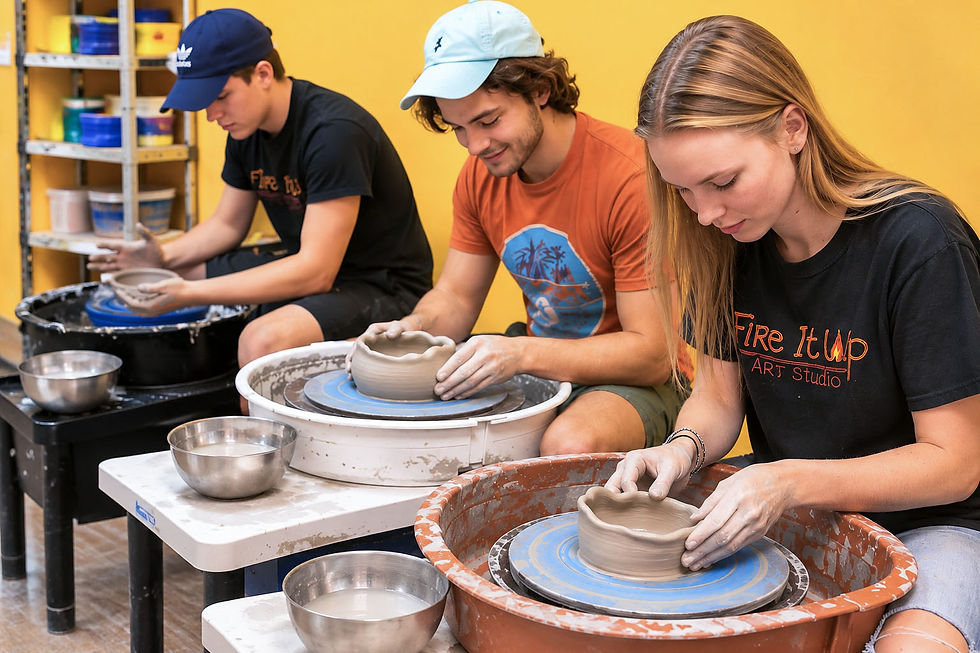
Anyone who has tried the pottery wheel knows this moment. The wheel spins, your hands get covered in clay, and instead of cooperating, the clay bumps and wobbles like it has its own agenda.
Beginners often think they’re doing something wrong—or that centering requires strength or some secret technique only experienced potters understand.
But after years of throwing and teaching thousands of students, I’ve come to explain centering in a much simpler way:
Centering is really about balance.
The Clay Isn’t Fighting You — It’s Following the Rules

When clay is off-center, its mass isn't distributed evenly around the center of the spinning wheel. That's what creates the wobble you feel against your hands every time the clay comes around.
Your job isn't to overpower the clay. Your job is to use steady, controlled pressure to move that uneven mass toward the center of the wheel.
As the clay becomes more evenly distributed around that center point, the wobble gets smaller. Eventually, your hands stop feeling that repeated bump and the clay begins to feel almost still—even though the wheel is spinning beneath it.
That's the strange thing about centering: the clay hasn't stopped moving at all. It's simply moving evenly. And that's where the physics comes in.
Why Centering Clay Has a Learning Curve
Knowing what needs to happen and getting your hands to actually do it are two different things.
Centering is a physical skill your body has to learn. Your hands have to work together while your arms stay braced and your pressure remains steady—all while the wheel is spinning. At first, that's a lot to coordinate.
But with practice, your hands begin to recognize what centered clay feels like. You start noticing smaller changes in the clay and making adjustments almost without thinking about them.
That's why almost anyone can learn to center. It isn't a talent reserved for artists or people with especially strong hands. It's a skill developed through repetition, guidance, and practice.
The Moment It Clicks

I see it happen all the time in classes.
A student struggles, pushing harder and harder, trying to control the clay. Then I ask them to slow down, brace their arms, and focus on being steady instead of strong.
Suddenly, the wobble begins to disappear. Their eyes get wide, and they say:
“Oh… I feel it.”
That quiet, smooth sensation—when the clay almost feels still even though the wheel is spinning fast—is the feeling potters learn to recognize.
That's centered clay. And it has very little to do with muscle and everything to do with consistency.
Thinking About Physics Changes Everything
When you think of centering as a battle, it’s frustrating. When you think of it as creating balance, it becomes much easier to understand.
You’re not forcing clay into submission. You’re steadily moving an uneven mass until it rotates evenly around the center of the wheel.
The wheel provides the motion. Your hands provide the pressure and stability. And when everything comes into balance, you feel it.
Maybe that’s one of the reasons pottery is so addictive. Something that looks almost magical when you first see it turns out to be something your own hands can learn to do.
Simple physics. Timeless pottery wisdom.
Want to Feel Centering for Yourself?
Reading about centering is one thing. Feeling it happen under your hands is something completely different—and a little bit magical the first time it works.
Our One-Time Wheel Classes are designed for beginners—no experience needed. Private lessons are also available for those who want more individualized instruction.
You might just discover what I did all those years ago—that a spinning wheel, a lump of clay, and a little simple physics can turn into something pretty amazing.